Culverts and Sinkholes: What’s Happening to Your Yard?
Wondering if a hidden culvert or drain is causing sinkholes in your yard or driveway? Learn how culverts work, why they fail, and what proper repair involves.
“Do I Really Have a Culvert… and Is It Causing Sinkholes?”
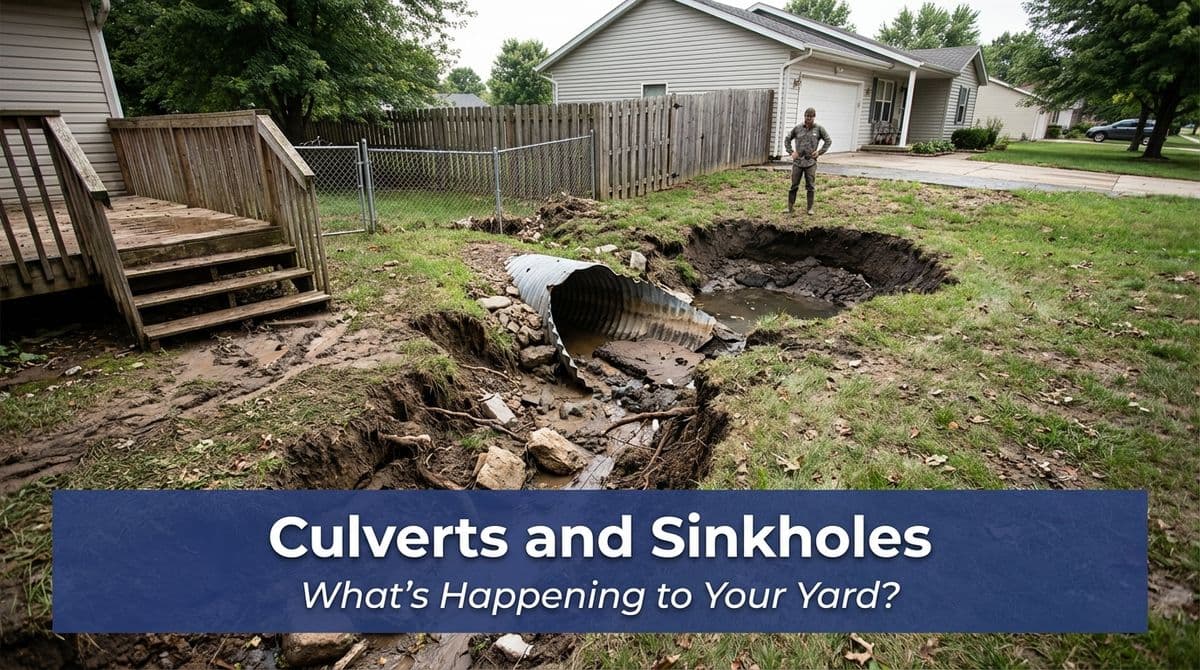
We recently got a call from a homeowner — let’s call him John — who had a mystery on his hands. He had sinkholes forming under his deck and along his sidewalk, and another contractor had told him, “You’ve got a failed culvert under there.”
When we came out and took a look, we saw a couple of small PVC drain pipes, but no obvious concrete box or large pipe like we’d expect from a culvert. John was confused: “The water guy told me there’s a cement box culvert running under my deck. Is that what’s causing all these sinkholes? And does that mean my whole sidewalk and driveway have to be ripped up?”
We walked him through what a culvert actually is, how failing drainage can create sinkholes, and what repair or replacement really involves. Since this comes up a lot, we thought it would be helpful to share the same explanation here.
What Exactly Is a Culvert?
A lot of homeowners use the word “culvert” to mean any buried pipe, but technically, a culvert is a pass-through for water that runs under something built on top of it — like a road, driveway, sidewalk, or even a deck.
In simple terms, a culvert is:
- A pipe or box (concrete, metal, plastic, or masonry)
- Buried in the ground
- With an inlet and an outlet (you should be able to see both ends)
- Carrying water under a surface that people or vehicles use
We usually see:
- Round culverts – corrugated metal or large plastic pipe (12"–48" or larger)
- Box culverts – rectangular concrete “tunnels” for water
So if you’ve got water traveling under your driveway, sidewalk, or yard in a large buried pipe or box, you probably have a culvert system.
How Culverts Fail and Cause Sinkholes
When John mentioned sinkholes under his deck, our ears perked up. That’s a classic sign of hidden drainage failure. Whether it’s a true culvert or a makeshift drain line, when something below ground fails, the soil starts to move.
Here are the most common ways culverts (or buried drain pipes) fail and trigger sinkholes:
- Cracks, breaks, or missing sections – Water escapes into the surrounding soil instead of staying in the pipe or box.
- Separated joints – Older concrete or metal sections can pull apart, letting soil wash into the pipe and be carried away.
- Undersized pipes – Pipes that are too small for the volume of water can cause backups, overflows, and erosion around the structure.
- Improper slope – If the culvert doesn’t have a steady downhill pitch from inlet to outlet, water can sit, scour, and undermine the bedding.
- Clogging – Leaves, roots, and debris block the flow, forcing water to find “new paths” through the soil.
As water leaks out or finds gaps, it carries soil with it. Over time, that soil loss creates voids underground. The surface — your yard, sidewalk, deck, or driveway — looks fine until gravity wins and everything above collapses into the hollow area.
That’s when you see:
- Small sinkholes or depressions forming
- Slabs starting to tilt or crack
- Deck posts suddenly leaning or sinking
Warning Signs Your Culvert or Drain Is Failing
When we walked John’s property, we weren’t just looking for a visible culvert; we were looking for the symptoms around it. Here are signs homeowners should watch for:
- Soft, spongy ground over a known drain route
- Repeated sinkholes in the same general area
- Cracks in sidewalks or driveways that keep reappearing after patching
- Gaps under sidewalks where soil has washed away from the edges
- Standing water on one side of a driveway or deck after storms
- Visible erosion at the inlet or outlet of a culvert or drain
If you know you have a culvert crossing the front of your property at the street, you should be able to see both ends. If one end is buried, broken, or missing, that’s a red flag.
Why Sidewalks, Decks, Fences, and Driveways May Need Removal
One of John’s biggest worries was: “Does everything have to be ripped up?” We get that question a lot. The honest answer is: it depends where the culvert or failing pipe actually runs.
To properly repair or replace a culvert, we need to:
- Expose the entire problem area (not just the visible crack)
- Confirm the inlet and outlet locations
- Assess the soil conditions and voids around it
If the culvert or drain runs under:
- Decks – Often the entire deck or at least sections must come out so we can safely excavate and compact soil again.
- Sidewalks – Individual slabs may need to be removed and replaced after the repair.
- Fences – Fence panels and posts in the work zone typically come out so they’re not damaged.
- Driveways – Sometimes only a strip needs to be cut; other times a larger area must be opened if the culvert or box extends farther than expected.
With John, we explained that if there really was a concrete box culvert directly under his deck and sidewalk, those structures would have to be removed to get to it. There’s simply no safe way to dig out a failed culvert while leaving heavy structures sitting on top of compromised soil.
What Culvert Repair or Replacement Typically Involves
Every property is a little different, but most culvert or buried drain projects follow a similar sequence. When we tackle jobs like the municipal work we’ve done (think 48-inch pipes under roads), our process typically includes:
- Investigation & locating
We start by finding the inlet and outlet, checking pipe size and material, and using cameras or probes when possible to see what’s going on underground. - Planning the access
We determine which surfaces (deck sections, fence panels, sidewalk slabs, driveway areas) must be removed, and we discuss options with the homeowner. - Excavation
We carefully dig to expose the failing culvert or pipe, watching for voids and unstable soil so the area stays safe. - Repair or full replacement
- Small localized issues may be patched or relined.
- Severely deteriorated culverts are usually removed and replaced with new pipe or a new box section sized correctly for the flow.
- Backfilling and compaction
We refill the trench with appropriate material and properly compact it so it won’t settle and re-create sinkholes. - Rebuilding surfaces
We pour new concrete, reset pavers, reinstall fences, and coordinate with deck or driveway contractors as needed to put everything back together.
When to Call a Professional About Culvert or Drain Problems
If you’re seeing sinkholes, collapsing soil under a deck, or cracked and sinking concrete, it’s time to look beyond surface repairs. Patching a sidewalk over a void or filling a sinkhole with bagged soil is only a temporary band-aid if water is still washing everything out underneath.
We always tell homeowners: the key questions are “Where is the water supposed to go?” and “How is it getting there?” If the answer involves a hidden pipe or culvert, it’s worth having it inspected properly before the damage spreads.
If you’re unsure whether you even have a culvert, or you’ve been told there’s a failed one under your deck, sidewalk, or driveway, a professional investigation can give you clear answers and a plan to fix it before the next big sinkhole appears.